
Martingale Collar vs Regular Collar: Which Is Right for Your Dog?
If you've been shopping for a dog collar and found yourself confused by the options, you're not alone. The question we hear most often is a simple one: what's the difference between a martingale collar and a regular flat collar, and does it actually matter?
The honest answer is: it depends on your dog.
What's the difference?
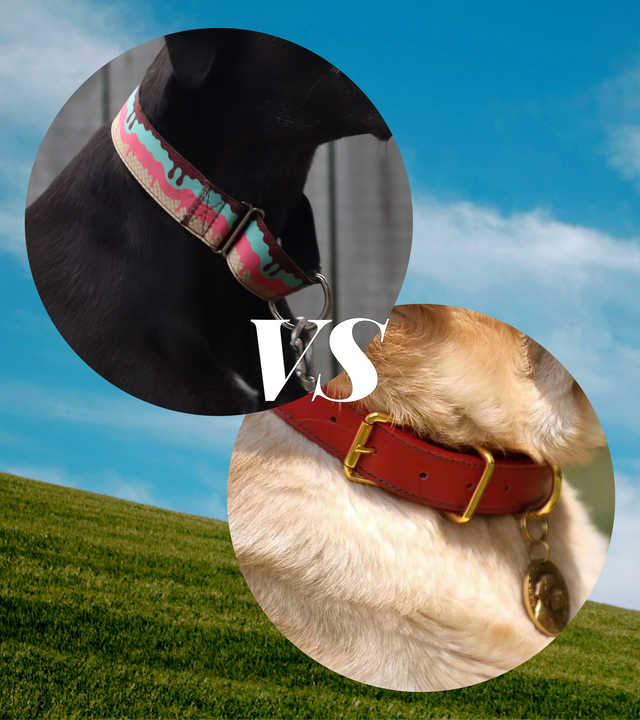
A regular flat collar is the classic strip of nylon or leather that buckles around your dog's neck. It stays the same size whether your dog is relaxed or pulling.
A martingale collar has two loops. The larger loop sits around your dog's neck; the smaller loop is where you clip the lead. When your dog pulls or tries to back out, the smaller loop tightens the larger one - but only to a preset limit. When pressure is released, it returns to its relaxed, comfortable fit.
When a martingale makes sense
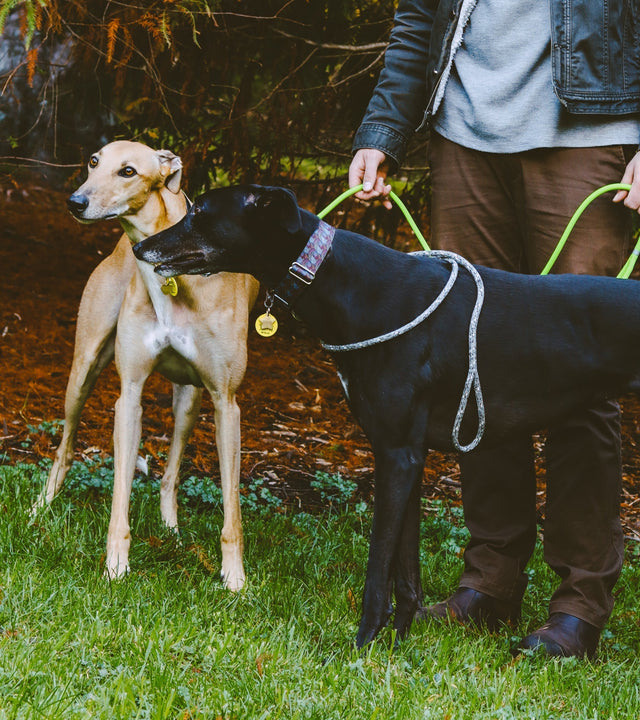
Martingale collars were originally designed for sighthounds - greyhounds, whippets, salukis, whose necks are wider than their heads, making it easy for them to slip out of a standard collar. If your dog has ever backed out of their collar mid-walk, a martingale solves that problem immediately.
They're also widely used by dog trainers and rescue organisations for newly adopted dogs, where anxiety can cause a dog to panic and bolt. Beyond sighthounds, martingales are a good fit for escape artists, dogs in leash training, and newly adopted dogs who need a secure but gentle collar while they settle in. A humane middle ground between a flat collar and a choke chain.
When a regular flat collar is fine
If your dog walks calmly on a loose lead and has no tendency to slip out, a regular flat collar does the job perfectly well. It's lighter, simpler, and great for home wear and holding ID tags.
An honest note on pulling
If your dog is a strong, persistent puller, neither a martingale nor a flat collar is the ideal solution. Research published in the Veterinary Record found that the pressure a collar puts on a dog's neck during pulling is enough to risk injury. For heavy pullers, most vets and trainers recommend a front-clip harness, which distributes pressure across the chest and shoulders instead. A martingale is gentler than a flat collar for moderate pulling, but it isn't a substitute for a harness or training if your dog is genuinely strong on the lead.
Martingale collars should also not be left on an unsupervised dog - the tightening loop can catch on things, so they're best kept for walks only.
Dogs that shouldn't use a martingale
Brachycephalic breeds - pugs, bulldogs, French bulldogs who already have compromised airways. Any collar that adds neck pressure isn't ideal; a well-fitted harness is the better choice. The same applies to dogs with existing tracheal or neck issues.
So, which should you choose?
- Your dog slips out of their flat collar on the lead: martingale collar
- Your dog is a sighthound or has a narrow head: martingale collar
- Your dog is anxious and at risk of bolting: martingale collar
- Your dog is a strong, consistent puller: front-clip harness
- Your dog walks calmly and stays in their collar: regular flat collar
- Your dog walks calmly but you want a more comfortable option: martingale collar
- Your dog needs a collar for around the house or the yard: regular flat collar or ID tag collar
- Your dog is a flat-faced breed: harness
A practical approach many owners swear by is to treat the martingale like a walking jacket - it goes on when you grab the lead, and comes off when you get home. Your dog wears a simple flat collar with ID tags at all times, and the martingale is reserved for walks. Your dog will quickly learn that the martingale going on means an adventure is coming.
Thinking of trying one? It's worth taking two minutes over the size. A martingale only does its job when it's fitted properly, which means measuring your dog's head as well as their neck. Our martingale collar guide takes you through both.
If you're unsure, a conversation with your vet or a positive reinforcement trainer is always worthwhile.

1 Comment
I have two kelpies and swear by the Martingale collars, they are pullers and these are great for them, I also carry harness’s for city walking, but normally when going on long walks they don’t wear either, let them run free.