Martingale Collar Guide
What is a Martingale Collar?
Martingale dog collars are also known as Greyhound collars, or Sighthound collars, because sighthounds' necks are larger than their heads and they can often slip out of traditional dog collars.

How does a martingale collar work?
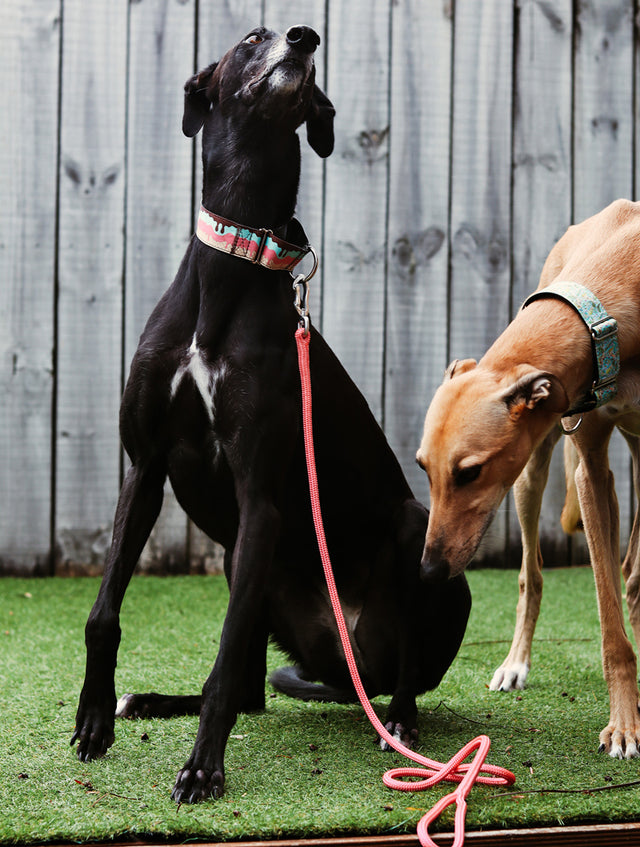
A martingale collar is made with two loops. The large loop is placed around your dog's neck and adjusted to fit loosely around the base of the neck. The smaller loop holds the D-ring where the leash attaches.
A wider collar is recommended for martingale-style collars as it distributes pressure more evenly across the neck, reducing strain and improving comfort. Our martingale collar is 38mm (1.5") wide across all sizes.

When your dog tries to pull, the tension on the leash pulls the small loop taut, which makes the large loop smaller on the neck.
Unlike traditional collars that must be tight to prevent escape, a properly fitted martingale sits comfortably and only tightens when needed, distributing pressure safely and evenly.
Why do trainers use martingales?
Martingales are recommended by trainers for improving leash walking. They offer gentle control while reducing pulling and preventing escape.
Is it only for Greyhounds?
No — martingale collars are suitable for many breeds. While especially helpful for sighthounds, they can be a safe and comfortable option for a wide range of dogs when fitted properly.

They are gentler than choke collars and provide better control in certain situations, especially for dogs that pull or slip out of standard collars.
Can a dog wear it all the time?
Martingales are designed for on-leash use. We recommend using it like a dog jacket — put it on for walks and remove it at home.
Sizing Guide
Follow the steps below to get both measurements before choosing your size.
Step 1 — Take two measurements
Head measurement
Use a soft measuring tape
Use a soft tape measure to form a loop. Adjust the loop until it can easily slide over your pup's head.
Check it slides off comfortably
Once the loop is on, confirm it can also slide back off without hurting your pup's ears. Then measure the length of the loop — this is your head measurement.
Neck measurement
Measure where the collar will sit
Measure the circumference of your dog's neck at the position where you'd like the collar to sit during use — typically at the base of the neck, just above the shoulders.
Compare to sizes
Add 3cm and check both measurements
Add an extra 3cm to each measurement for comfort. Then compare both numbers to our size ranges below. The correct size is one that covers both your head and neck measurements.
Step 2 - Choose your size
27 – 36 cm
collar circumference
Whippet · Italian Greyhound · Small Greyhound etc.
36 – 48 cm
collar circumference
Greyhound · Vizsla · Huntaway · Thai Ridgeback · Border Collie · Labradoodle · Dalmatian etc.
44 – 64 cm
collar circumference
Golden Retriever · Labrador · German Shepherd · Wolfhound · Malamute · Husky · Afghan Hound · Boxer etc
Collar width: 38mm (1.5″) — all sizes. Breed examples are a guide only.
Step 3 — Check for a correct fit

Slip on easily
Adjust the collar so it’s big enough to easily slip over your dog’s head and ears.

Correct neck position
Once around the neck, tighten it down to a comfortable size with wiggle room. When relaxed, the collar should sit at the base of the neck, not riding up toward the ears.

Two-finger rule
When relaxed, you should be able to easily fit at lease two fingers in between your pup’s collar and neck. Any tighter and it's too small.

Martingale tightening check
When tightened, the two slides that form the small loop should not be able to touch. When you release the small loop, it should hang at the base of the neck comfortably.