Rope Lead vs Flat Nylon Lead: Which Is Better for Your Dog?
When we brought our first greyhound Zephyr home, we were handed a standard nylon lead. It did the job, technically. But walking a nervous, newly adopted greyhound on a flat nylon lead was a lesson in frustration. The webbing was wide and floppy with no real structure, the loop handle was oversized and awkward to grip, and when Zephyr spooked and lurched, the nylon slipped through our hands and left a red stripe across our palms. It wasn't a great start.
That experience was a big part of why we started making our own dog leads.
What's the difference?
A nylon lead is made from flat woven nylon webbing, budget-friendly, lightweight, and widely available. It's genuinely durable to outdoor conditions.
A rope lead is made from twisted or braided rope, typically polypropylene, polyester, or cotton -- with a round, ergonomic grip that's comfortable to hold, especially under load.
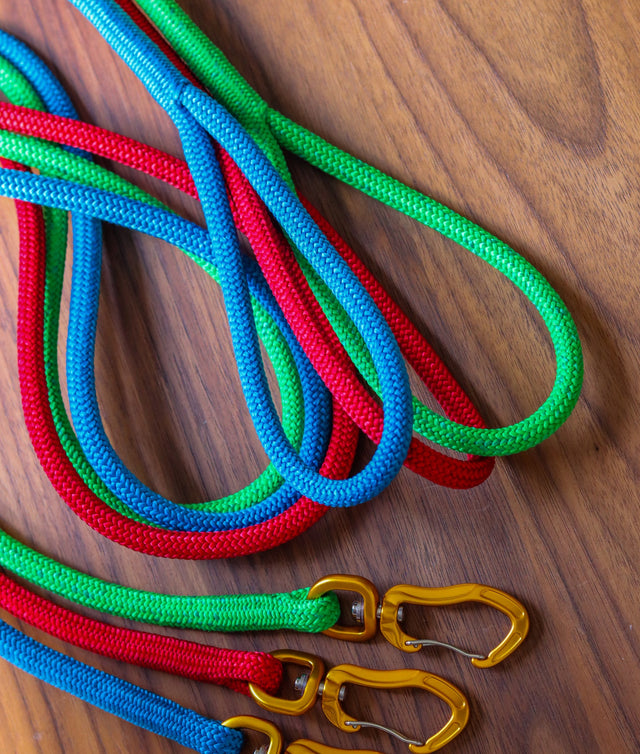
At Woofo, we use double braid rope - the marine standard - with a strong inner braid for strength and an outer cover for abrasion resistance. Our rope is made by a New Zealand ropemaker with over 60 years of experience, using quality fibres with environmental sustainability in mind. Each lead has a 400kg strength rating and weighs just 100 grams.
Where rope leads genuinely win
Durability is strong on both sides, but rope leads - particularly those made from marine-grade materials - tend to outlast nylon over the long term. Nylon webbing can fray, especially if your dog is a chewer, and the flat weave degrades faster under sustained UV exposure in climates like New Zealand and Australia.
Comfort in hand is where rope pulls clearly ahead. The ergonomic round grip sits naturally in your palm in a way flat nylon simply doesn't. More importantly, twisted rope fibres naturally swell and provide better grip when wet or under tension, whereas flat nylon can become slick and difficult to hold at exactly the moment you need control most. Nylon is also the main culprit behind leash burn, the friction injury that occurs when a lead slips through your hand during a sudden pull. Multiple veterinary and medical sources confirm that flat nylon is one of the most common causes of this injury.
Versatility: a bonus most people don't expect. The natural flexibility of rope means you can tie it into a snug waist loop for hands-free walking or running, create a makeshift handle for extra control in busy areas, or quickly adjust the working length by looping it around your hand.
However, not all rope leads are made the same and the joins matter most
When it comes to rope leads, the quality of the construction is just as important as the quality of the rope itself. The most common way to finish a rope lead is with stitching, glue, or a simple knot - all of which introduce a weak point into the lead. Research from marine rope manufacturers consistently shows that a knot can reduce a rope's breaking strength by up to 50-60%, while stitched joins can fail under sustained load or UV degradation over time.
The traditional alternative is splicing - a technique developed in the sailing industry where the rope strands are woven back into themselves to form a loop. A correctly executed splice retains up to 90-95% of the rope's original breaking strength, with no bulky knot and no stitching that can fray or unpick. It takes considerably more time and skill to do well, which is why most mass-produced leads don't use it.
At Woofo, every rope lead is finished using traditional rope splicing techniques. It's slower to make, but the result is a lead with no weak points - just continuous rope from handle to clip.
Where flat nylon leads have the edge
Price is the obvious one. A basic nylon lead costs a fraction of a quality rope lead. If you need a spare, a training lead, or something for a foster dog, nylon makes complete sense.
Nylon is lightweight, which some owners prefer for small dogs or puppies. It's worth noting that not all rope leads are heavy - our classic leads weigh under 200 grams, lighter than most people expect.
What about other lead types?
Leather leads are comfortable, beautiful, and long-lasting, but they require regular conditioning, don't love water, and carry a higher price tag.
Biothane leads are becoming popular for good reason: they're waterproof, easy to clean, and very durable. If you have a water-obsessed dog or walk in very muddy conditions regularly, biothane is worth considering.
Retractable leads deserve a special mention and not a good one. They're associated with a significant number of injuries to both dogs and owners, including cord burns severe enough to require medical treatment and, in extreme cases, finger amputations from cord entanglement. Most vets and trainers recommend avoiding them entirely.
The bottom line
Both nylon and rope leads are durable and will get the job done. The real difference comes down to grip, comfort, and construction. If you walk daily and want a lead that feels great in hand, gives you genuine control when it counts, and is built to last - a well-made spliced rope lead is worth every cent. Nylon is a perfectly honest choice for a spare or a budget option. But once you've walked with a quality rope lead, it's hard to go back.

0 Comments
There are no comments for this article. Be the first one to leave a message!