
Spliced, Not Knotted: Why the Joins in a Rope Lead Matter
Most people choose a dog lead by colour, length, and whether the clip looks like it will survive the year. Almost nobody looks at the joins.
Which is a shame, because the joins are the part that fails.
Every rope lead has at least two of them. One where the rope loops back on itself to make the handle, and one where it wraps around the clip. Whatever holds those two loops closed is the weakest point in the entire lead. The rest is just rope.
So it is worth knowing what your lead is actually held together with.
Three ways to close a loop
Knotting. The fastest and cheapest option, and the one you will find on a lot of budget rope leads. The trouble is that a knot forces the fibres around a tight bend, and all the load concentrates right at that bend. As a rule of thumb, a knotted rope holds roughly 40 to 50 percent of the strength it had before you tied it. You have thrown away half your rope before the dog has even pulled.
Gluing, crimping or stitching. A step up. The loop is closed with a metal ferrule crimped over it, or with adhesive, or with thread sewn through. Stronger than a knot, but the join now depends on a third material rather than the rope itself. It also creates a hard point, and hard points are the bits that dig into your palm or clatter against your dog's collar. When they do go, they tend to go without much warning, because you cannot see inside a crimp.
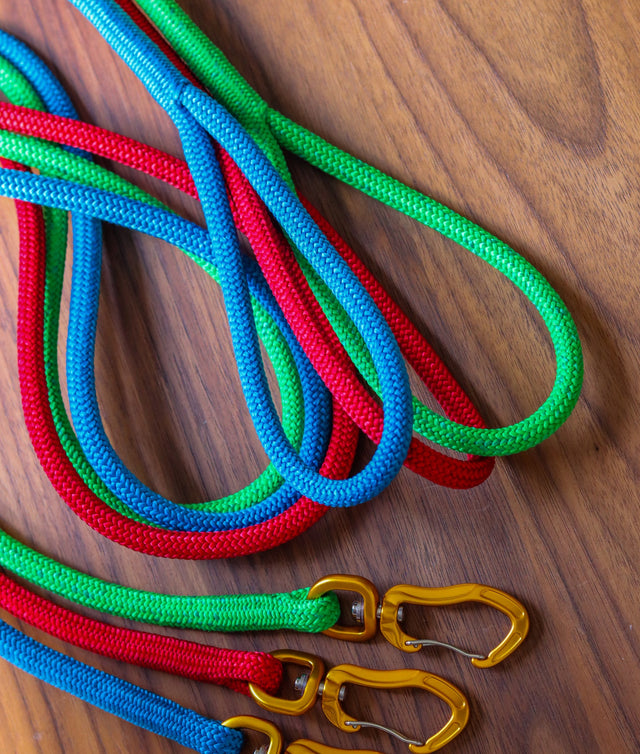
Splicing. No knot, no glue, no thread, no metal sleeve. A splice joins rope or forms a loop by threading the rope's own strands back through itself, rather than tying a knot. It keeps 90 percent or more of the rope's original strength, sits flat enough to pass cleanly through hardware. It is how every Woofo rope lead is made.
What a splice actually is
Marine double braid rope is a rope inside a rope. There is a braided core that carries most of the load, sitting inside a braided cover that protects it.
To splice it, you separate those two layers and bury each one back inside the other, then let the rope's own structure hold the join closed. Nothing is added. Nothing is tied.
The clever part is what happens under load. As the rope is pulled, the cover tightens down onto the buried core and grips it harder. It is the same principle as a Chinese finger trap. The harder your dog pulls, the more securely the join holds.
Done properly, a splice keeps around 90 to 95 percent of the rope's original strength. Compare that to the 40 to 50 percent you get from a knot and you can see why it is worth the extra time.
Why the technique comes from sailing
Because on a boat, a join that fails is a genuinely serious problem. Splicing has been the standard method for terminating and joining rope on boats for centuries, long before anyone thought to put a dog on the end of one. Riggers do not knot a halyard. They splice it, because it is stronger, it runs smoothly through hardware, and it can be inspected by eye.
A dog lead is a much smaller problem than a mainsheet in a southerly. But it is the same problem, and it already has a good solution.
How ours are made
Joe splices every rope lead we sell, by hand. Each one is made to order, which is why there is a short wait rather than a shelf full of stock.
The rope comes from a New Zealand ropemaker with more than sixty years of experience, and it is proper marine grade double braid, the same construction used on boats.
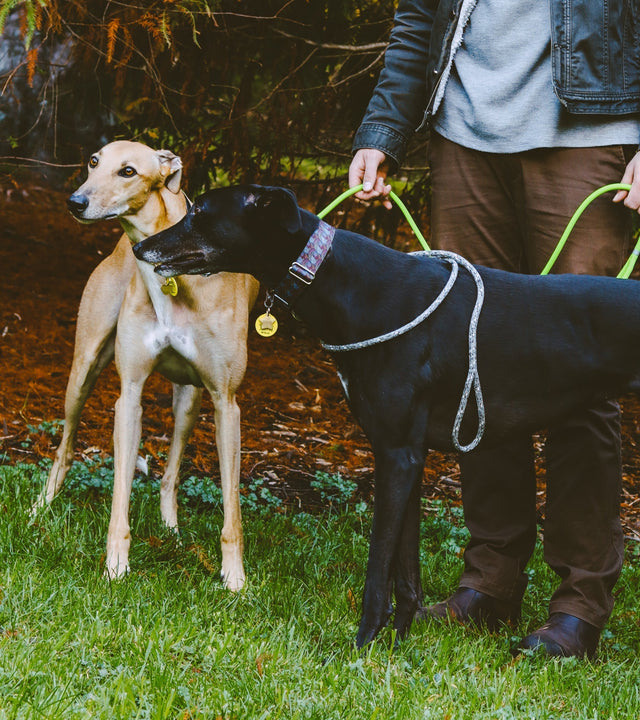
On our leads, the splice is not the limiting factor. It is rated far beyond anything a dog can generate. The hardware is the ceiling, with our aluminium swivel clips rated to 400kg. Which is a comfortable margin for a greyhound who has spotted a rabbit.
Have a look at what we make
Every lead is spliced by hand and made to order, in everyday walk collection or our speciality leads collection.
Not sure which lead or what length you need? Our rope lead guide walks through it.

0 Comments
There are no comments for this article. Be the first one to leave a message!